

 All Products


What is Tantalum Capacitor?
 Dec 06, 2024
 683
683Catalog
What are tantalum capacitors?Tantalum Capacitor DefinitionTantalum Capacitor CharacteristicsConstruction and Properties of Tantalum CapacitorsApplications for Tantalum CapacitorsAlternatives to Tantalum Electrolytic CapacitorsFrequently Asked QuestionsRelated ArticlesWhat are tantalum capacitors?
Tantalum capacitors are a type of electrolytic capacitor. They’re built using tantalum metal as the anode, with a thin oxide layer serving as the dielectric, and a conductive material as the cathode. Thanks to the properties of tantalum, the dielectric layer can be incredibly thin, giving these capacitors a high capacitance-to-volume ratio. This means they’re compact but pack a punch when it comes to performance. They also have excellent frequency characteristics and are stable over time.
However, tantalum capacitors are polarized, so you need to make sure you connect them with the correct polarity when used with DC circuits. One drawback is their failure mode—if things go wrong, they can overheat, catch fire, or even explode. But don’t worry, this risk can be reduced by using protective measures like current limiters or thermal fuses.
With advancements in technology, tantalum capacitors are now common in many applications, like laptops, cars, and cell phones. Most of them are made as surface-mount devices (SMD), which save space on the circuit board and allow for higher component densities.
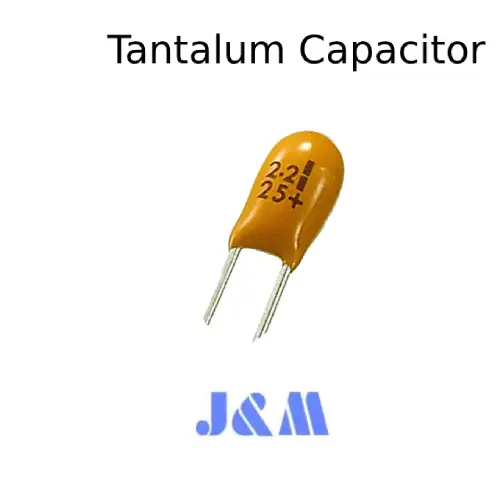
Tantalum Capacitor
Tantalum Capacitor Definition
Tantalum capacitors are a type of electrolytic capacitor that use tantalum metal as the anode. They’re polarized and are known for their excellent frequency response and stability.
Tantalum Capacitor Characteristics
General Characteristics
Tantalum capacitors come in a wide range of capacitance values, from as small as 1nF to as large as 72mF. They’re much smaller than aluminum electrolytic capacitors with the same capacitance, making them ideal for compact designs. Their voltage ratings range from 2V to over 500V.
One standout feature is their low equivalent series resistance (ESR), which is up to ten times smaller than that of aluminum electrolytics. This allows them to handle higher currents with less heat buildup. Tantalum capacitors are also incredibly stable over time—their capacitance doesn’t change much with age, especially compared to aluminum electrolytic ones. Plus, if stored and used properly, they’re highly reliable and have an almost unlimited shelf life.
Polarity
Tantalum capacitors are highly polarized, meaning they need to be connected correctly in a circuit. Unlike aluminum electrolytics, which might tolerate a brief reverse voltage, tantalum capacitors are very sensitive to it. Applying reverse polarity can break down the dielectric layer, often leading to a short circuit. Over time, this short can cause thermal runaway and potentially destroy the capacitor.
To help with proper connection, the positive terminal of a tantalum capacitor is typically marked, whereas aluminum electrolytics usually mark the negative terminal.
Failure Mode
Tantalum capacitors do have a risky failure mode. If there’s a voltage spike, the tantalum anode can come into contact with the manganese dioxide cathode, which can trigger a chemical reaction. If the spike has enough energy, this reaction generates heat and can lead to smoke or even flames.
To prevent this, it’s a good idea to use external safety components like current limiters or thermal fuses in circuits with tantalum capacitors. This helps minimize the risk of thermal runaway and keeps things safe.
Construction and Properties of Tantalum Capacitors
Tantalum electrolytic capacitors, like other electrolytic types, are made up of three main parts: an anode, an electrolyte, and a cathode. The anode is separated from the cathode, so only a tiny amount of leakage current flows through the capacitor. The anode itself is made from pure tantalum metal. This tantalum is ground into a fine powder and then sintered into a pellet at high temperatures. This process creates a very porous anode with a huge surface area, which directly boosts the capacitance value.
Next, the anode gets coated with a layer of insulating oxide that acts as the dielectric. This step, called anodization, is carefully controlled to make sure the dielectric thickness is just right, as it affects the final capacitance value.
For solid tantalum capacitors, the electrolyte is added through a process called pyrolysis. The anode is coated with manganese dioxide by dipping it into a special solution and baking it repeatedly until the coating is thick enough to cover all surfaces. After this, the pellet is dipped in graphite and silver to create a solid cathode connection.
In contrast, wet tantalum capacitors use a liquid electrolyte instead of a solid one. After the anode is sintered and coated with its dielectric, it’s immersed in liquid electrolyte inside a sealed enclosure. This enclosure, combined with the liquid electrolyte, acts as the cathode for wet tantalum capacitors.
Applications for Tantalum Capacitors
Tantalum capacitors are used in applications that need low leakage current, high capacitance, and long-term stability. For example:
- Sample-and-hold circuits: These require low leakage current for long hold times.
- Power supply filtering: Found on computer motherboards and cell phones due to their small size and stable performance (often in SMD form).
- Military equipment: Tantalum capacitors in MIL-SPEC versions offer tight tolerances and wider temperature ranges. They’re often preferred over aluminum electrolytics because they don’t dry out over time.
- Medical electronics: Their high stability makes them reliable for sensitive devices.
- Audio amplifiers: Used in circuits where stability is critical.
Thanks to these properties, tantalum capacitors are a solid choice for applications requiring compact, reliable, and stable performance over the long haul.
Alternatives to Tantalum Electrolytic Capacitors
When it comes to tasks like filtering, coupling, decoupling, and bypassing, circuit designers usually pick from a few main options: aluminum electrolytic, tantalum electrolytic, niobium electrolytic, or multilayer ceramic chip (MLCC) capacitors. Here’s a quick comparison to help you see how these options stack up:
| Attributes | Tantalum electrolytic capacitor | Multilayer ceramic chip (MLCC) capacitor | Aluminum electrolytic capacitor | Niobium electrolytic capacitor |
| Dielectric type | Tantalum pentoxide | Various ceramics | Aluminum pentoxide | Niobium pentoxide |
| Approximate capacitance range | 0.47 µF to 1,000 µF | 0.01 µF to 100 µF | 1 µF to 10,000 µF | 2.2 µF to 1,000 µF |
| Voltage range | 2.5 V to 50 V | 6.3 V to 250 V | 4 V to 400 V | 3.3 V to 10 V |
| Advantages | Small size, high reliability, stable capacitance value | Non-polarized, works well at higher frequencies | Broad range of capacitor values and voltage ratings, inexpensive and readily available | Catastrophic failure modes are safer than tantalum, and these capacitors offer very high reliability, making them a great choice for critical systems. |
| Disadvantages | Polarized, common catastrophic failure mode is to become a short circuit | Prone to chipping and cracking, large capacitance variations. | Polarized, relatively large size, leakage may limit lifetime | However, they are polarized, have a more limited range of capacitance values, and aren’t as space-efficient (volumetrically) as tantalum. Their voltage ratings are lower, and their ESR isn’t as low as tantalum’s either |
Frequently Asked Questions
What’s special about tantalum capacitors?
Tantalum capacitors are widely used in devices that need stable capacitance, low leakage current, and high reliability. Thanks to their durability and performance in extreme conditions, they’re commonly found in medical equipment, aerospace tech, and military applications.
Why aren’t tantalum capacitors always used?
The main issue is their failure mode. When they fail, they often short-circuit, which can cause them to draw a lot of current and even start a fire. For this reason, devices designed to UL standards typically don’t allow tantalum capacitors in power circuits.
Why are tantalum capacitors so expensive?
It’s mostly due to the materials. Tantalum is a rare earth metal, making it costly. These days, ceramic capacitors are often chosen over tantalum unless there’s a specific need for their unique properties.
What’s the difference between tantalum and electrolytic capacitors?
Tantalum capacitors use high-purity tantalum powder and tantalum pentoxide as the dielectric. In contrast, general electrolytic capacitors use a metal anode that forms an oxide layer through anodization.
Do tantalum capacitors degrade over time?
Unlike MLCCs, which can age and lose capacitance, polymer tantalum capacitors offer long-term stability, often maintaining performance over a 20-year lifespan.
Which is stronger: tantalum or titanium?
It depends on what you mean by "stronger." Titanium is much lighter and more scratch-resistant than tantalum. However, some people prefer tantalum for its heavier feel, especially in items like rings.
What are the issues with tantalum capacitors?
Tantalum capacitors are very sensitive to polarity. Connecting them the wrong way or exposing them to reverse voltage can cause degradation or even catastrophic failure, like a short circuit.
Related Articles
Air Conditioner Capacitors: Everything You Need to Know (2025)
CBB61 Capacitors: What They Are and How to Use Them

Christopher Anderson
Christopher Anderson has a Ph.D. in electrical engineering, focusing on power electronics. He’s been a Senior member of the IEEE Power Electronics Society since 2021. Right now, he works with the KPR Institute of Engineering and Technology in the U.S. He also writes detailed, top-notch articles about power electronics for business-to-business electronics platforms.
Subscribe to JMChip Electronics !