

 All Products


Everything You Need to Know About Potentiometers in Circuit Design
 Sep 21, 2024
 1539
1539Catalog
What is a potentiometer?Different Types of PotentiometersHow Do Potentiometers Work?Potentiometer Resistance RatingsA Word About Potentiometer TaperHow to Choose the Right PotentiometerIn this text, we’ll explore potentiometers in detail, covering what they are, their construction and symbol, how they work, the various types available, and their applications as both a rheostat and a voltage divider.
What is a potentiometer?
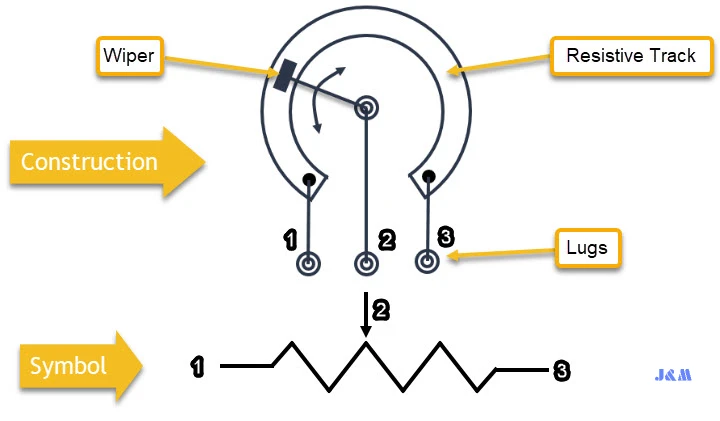
A potentiometer is a three-terminal device that adjusts resistance using removable contacts. It is a variable resistor with sliding contacts that can be adjusted to change the resistance between the contacts and the terminals.
We know resistors. They stop current in a circuit. Ordinary resistors have a fixed resistance. But what if you want to change it? That's where potentiometers come in.
Different Types of Potentiometers

Potentiometer Types Comparison
| Type | Features | Advantages | Typical Applications |
| Rotary Potentiometer | Circular motion, knob or dial for adjustment | Durable, precise control | Volume control in audio equipment, industrial control systems |
| Linear Potentiometer | Straight-line motion, proportional control | Direct and proportional control | Position sensing in robotics, automotive throttle control |
| Slider Potentiometer | Sliding knob, user-friendly interface | Intuitive, easy manual adjustment | Sound mixing boards, lighting controls |
| Trimmer Potentiometer | Compact size, fine-tuning adjustment | Precise, stable, small form factor | Circuit tuning and calibration, setting biasing levels |
| Digital Potentiometer | Digital signals, no mechanical movement | High precision, programmable, no wear | Digital audio systems, automated test equipment |
How Do Potentiometers Work?
The resistance of an object depends on several factors. When all other conditions remain the same, resistance is directly proportional to the object's length. For example, a 10 cm object made of the same material with the same cross-sectional area will have half the resistance of a 20 cm object. Potentiometers operate based on this principle. The adjustable output is achieved by moving a sliding contact along a uniform resistive element, either in a straight line or a rotary motion, altering the path length through which current flows. The input voltage is applied across the entire resistive element, while the output voltage is measured as the drop between the fixed resistive element and the sliding or rotating contact. The position of the movable contact determines how much of the input voltage is applied to the circuit.
Potentiometers typically control low power levels, rarely exceeding one watt, as dissipating higher power would generate excessive heat. Instead, they adjust analog signals, which other components then use to control power. For instance, a basic light dimmer employs a potentiometer to control a TRIAC, which regulates the brightness of the light.
Potentiometer Resistance Ratings
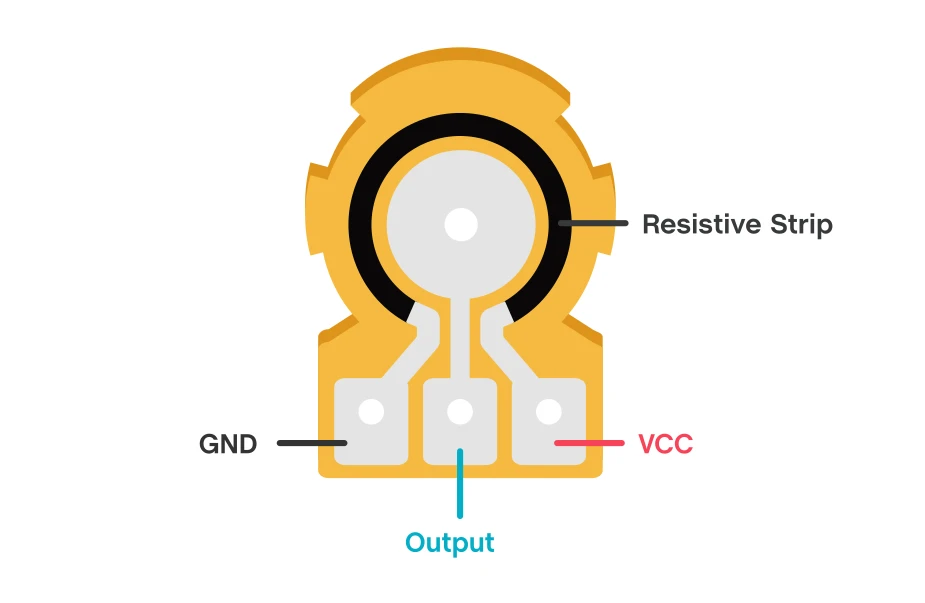
Potentiometers are generally characterized by their total resistance value, which represents the resistance between the two outer terminals of the device. For instance, a potentiometer rated at 1 kΩ (kilohms) has a resistance equivalent to that of a 1 kΩ fixed resistor across its resistive track.
Other key parameters to consider include:
- Rated Power: The maximum power the potentiometer can handle without being damaged.
- Resolution: The precision of the potentiometer, defined as the percentage of total resistance and the incremental resistance change with each movement of the contact along the resistive track.
- Sliding Noise: The level of electrical noise generated by the movement of the internal contact parts.
- Temperature Coefficient: The variation in resistance caused by changes in the operating temperature.
- Mechanical Life: The device's durability, typically measured in the number of cycles it can complete while maintaining its performance.
A Word About Potentiometer Taper
Potentiometer taper refers to how the resistance changes as the armature rotates or the wiper moves along the resistive element. In some designs, this change follows a linear pattern, meaning that when the armature or wiper is positioned in the middle, the resistance is half of the total resistance of the potentiometer.
Other designs feature a non-linear, logarithmic taper (also known as an audio taper), which more accurately reflects the logarithmic response of human hearing. This results in a smoother and more balanced volume adjustment throughout the full range of movement in audio controls. There are also reverse logarithmic potentiometers, designed to work in the opposite manner, often used in counterclockwise-operating audio controls.
How to Choose the Right Potentiometer
When choosing a potentiometer, it's important to take several key factors into account to ensure it fits your application’s needs:
Resistance value: Select a resistance value that aligns with your circuit requirements. Standard values range from a few ohms to several megaohms. Make sure the chosen value offers the control range you need.
Tolerance: Review the tolerance rating, which indicates how much the actual resistance may deviate from the nominal value. A lower tolerance (e.g., ±1%) offers greater accuracy, while a higher tolerance (e.g., ±20%) provides less precision.
Physical size: Ensure the potentiometer's size is appropriate for the available space in your design. Consider the form factor—such as rotary, linear, or trimmer—based on design limitations and user interface requirements. Power rating: Check the potentiometer’s power rating to confirm it can handle the power levels in your circuit without overheating or failing, especially in high-current or high-voltage applications.
Application type: Choose a potentiometer that’s suited to your specific application. For instance, rotary potentiometers are often used in audio devices, linear potentiometers in position sensing, and trimmer potentiometers for fine-tuning circuit performance.
Quality and Reliability Tips
Material quality: Choose potentiometers made from durable materials like conductive plastic or cermet to enhance performance and longevity. Environmental resistance: Ensure the potentiometer can withstand environmental challenges, such as temperature changes, humidity, or vibration, depending on your application.
Lifespan and durability: Consider the expected lifespan, often measured in cycles, to ensure the potentiometer can meet your application’s durability requirements.
By considering these aspects, you can select a potentiometer that provides reliable, long-term performance for your specific needs.

Amanda Miller
Amanda Miller is a senior electronics engineer with 6 years of experience. She focuses on studying resistors, transistors, and package design in detail. Her deep knowledge helps her bring innovation and high standards to the electronics industry.
Subscribe to JMChip Electronics !