

 All Products


What is a Crystal Oscillator?
 Feb 11, 2025
 732
732Catalog
What are Crystal Oscillators?Key Components of a Crystal OscillatorTypes of Crystal OscillatorsThe Science Behind Crystal OscillatorsOperating Principles of Crystal OscillatorsApplications of Crystal OscillatorsAdvantages and DisadvantagesSelecting the Right Crystal OscillatorFrequently Ask QuestionsRelated ArticlesWhat are Crystal Oscillators?
A crystal oscillator is an electronic circuit designed to produce a precise electrical frequency, relying on the mechanical vibrations of a crystal. It works based on the principle of piezoelectricity and is generally constructed from specific materials, with quartz being the most common. The oscillations of the crystal itself set the frequency, providing a stable timing signal for devices like wristwatches to measure time or, in telecommunications, to control complex systems like 3G and 4G technologies.
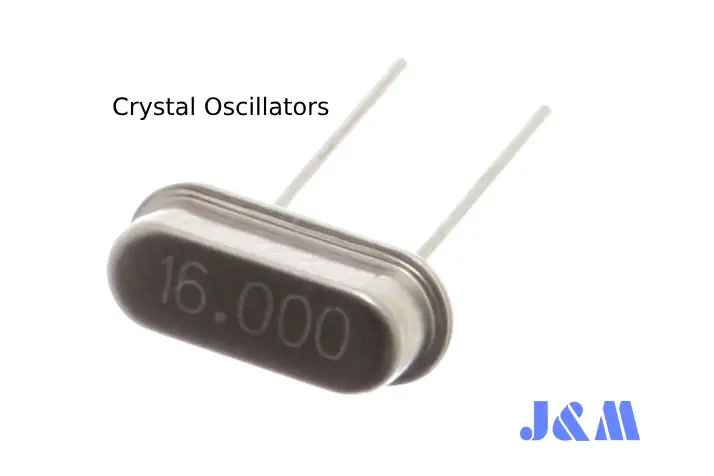
crystal oscillator
Key Components of a Crystal Oscillator
- Crystal: Typically crafted from quartz, this is the core element of the oscillator.
- Oscillator circuit: Usually includes an amplifier and a feedback network.
- Capacitors: Used for tuning the frequency and maintaining stability.
- Resistors: Essential for biasing and managing the operation of the oscillator.
- Power supply: Delivers the energy required for the oscillator to continue functioning.
Types of Crystal Oscillators
- Pierce oscillator: A widely used type in microcontrollers and digital circuits.
- Colpitts oscillator: Noted for its reliability and often used in radio frequency applications.
- Temperature-compensated crystal oscillator (TCXO): Designed to maintain stable performance despite temperature fluctuations.
- Oven-controlled crystal oscillator (OCXO): Known for excellent temperature stability, as it is largely unaffected by external environmental changes.
The Science Behind Crystal Oscillators
Explanation of the Piezoelectric Effect
Simply put, the piezoelectric effect is a phenomenon where certain crystalline substances, mainly quartz, generate an electrical charge when subjected to mechanical stress, and conversely, deform when an electric field is applied. This principle of piezoelectricity underpins the operation of a crystal oscillator. When an electric field is applied to the quartz crystal, it slightly distorts and returns to its original shape once the field is removed, generating a small electrical current. The bidirectional energy conversion property explains why crystal oscillators are so accurate and dependable.
The Resonant Frequency and Its Significance
Every crystal has a natural resonant frequency at which it vibrates most efficiently. This frequency is mainly determined by the crystal's physical attributes, such as its size, shape, and the way it’s cut. When an alternating electric field is applied to the crystal at its resonant frequency, the crystal vibrates at that same frequency in a stable, self-sustaining pattern. The importance of this resonant frequency lies in its role as a stable and highly accurate reference point for timekeeping and frequency generation in various electronic systems.
How the Crystal Cut Affects Performance
The way a crystal is sliced from raw quartz material plays a critical role in its performance. Different cuts—such as AT-cut, BT-cut, or SC-cut—result in varying levels of frequency stability, temperature sensitivity, and aging behavior. For example, AT-cut crystals are popular for their excellent frequency stability across a broad temperature range, making them suitable for many applications. The cut of the crystal also affects its Q factor, which measures its ability to store energy and determines the precision of the oscillator’s frequency and its resistance to phase noise.
Operating Principles of Crystal Oscillators
Startup Process
The startup sequence begins when power is supplied to the crystal oscillator circuit. Initially, some electrical noise in the circuit provides a small amount of excitation to the crystal, causing it to start vibrating. This weak signal generated by the crystal is then fed back into the amplifier circuit.
The amplifier amplifies the signal, boosting its amplitude. The amplified signal is then sent back to the crystal, reinforcing its vibrations. This positive feedback loop continues until the oscillation stabilizes at a consistent amplitude, typically within a few milliseconds.
Steady-State Operation
As the signal’s four-second wavelength is amplified in the oscillator, its amplitude increases. This amplified feedback signal is sent back to the crystal, intensifying its vibrations. The positive feedback loop persists until the oscillation stabilizes at a steady amplitude, generally within a few milliseconds.
The crystal’s high Q factor (quality factor) ensures frequency stability. Acting as a narrow bandpass filter, it rejects frequencies that stray from the resonant frequency, maintaining a clean, single-frequency output.
Temperature Effects on Oscillation
Changes in temperature can greatly influence the operation of crystal oscillators. As the temperature fluctuates, the crystal’s size and elastic properties change, which in turn alters its resonant frequency, leading to frequency drift.
To compensate for these effects, specialized schemes are used. The TCXO (temperature-compensated crystal oscillator) adjusts the circuit around the crystal oscillator’s frequency to provide a relatively stable output that is directly influenced by known temperature variations. The OCXO (oven-controlled crystal oscillator) includes a temperature-regulated environment for the crystal, ensuring superior frequency stability by minimizing the impact of temperature changes.
Applications of Crystal Oscillators
A. Timekeeping Devices
Crystal oscillators play a vital role in timekeeping devices, acting as the pulse behind millions of clocks and watches. Their exceptional frequency stability is crucial for both analog and digital timekeeping systems. From basic wristwatches to large wall clocks, crystal oscillators ensure accurate timekeeping by providing a steady oscillation that drives the timekeeping mechanism.
B. Telecommunications
In telecommunications, crystal oscillators are key components that guarantee clear communication. They supply a stable reference frequency for radio transmitters and receivers, ensuring proper signal transmission and reception. This level of precision is essential for clear voice calls, data transfers, and satellite communications.
C. Digital Electronics
Crystal oscillators are fundamental to electronic circuits, generating clock signals used by microprocessors, microcontrollers, and various other devices. These signals are necessary for synchronizing multiple operations in sophisticated electronic systems. From computers to smartphones, crystal oscillators ensure seamless interaction between components, enabling the accurate processing of data and execution of instructions.
D. Aerospace and Military Use
Aerospace and military sectors depend on crystal oscillators for precise timing and frequency control in critical systems. They are used in navigation systems such as GPS, where accuracy is crucial for determining location. Crystal oscillators also play a role in radar systems, secure communication equipment, and flight control systems, where both reliability and precision are essential.
Advantages and Disadvantages
High-Frequency Stability
One of the major benefits of crystal oscillators is their high frequency stability. This makes them ideal for applications where accurate timing and synchronization are essential. The inherent properties of the crystal allow it to oscillate at a very consistent frequency, even over extended periods, with accuracy often reaching within a few parts per million. This is especially important in telecommunications, where precise timing is necessary for network synchronization.
Low Power Consumption
Crystal oscillators are also energy-efficient, making them well-suited for portable devices and battery-operated applications. They have been recognized as an efficient way to conserve power, extending battery life and reducing overall power consumption. This efficiency is particularly beneficial in modern IoT devices and wearable technology, where energy savings are critical.
Temperature Sensitivity
Despite their many advantages, crystal oscillators have some drawbacks, one of which is their sensitivity to temperature changes. Fluctuations in temperature can alter the crystal's resonant frequency, leading to timing errors. To address this issue, TCXOs (Temperature-Compensated Crystal Oscillators) and OCXOs (Oven-Controlled Crystal Oscillators) have been developed. These specialized oscillators include additional circuits or temperature regulation features to maintain stability across varying temperatures.
Aging Effects
Crystal oscillators also experience aging effects, which cause their frequency to shift slowly over time. This aging is due to factors like mechanical stress, contamination, or structural changes in the crystal. While the aging effect is typically minimal, it can become significant in applications where long-term stability is critical. For high-precision applications, periodic recalibration or comparison with atomic clocks may be necessary to account for this limitation.
Selecting the Right Crystal Oscillator
Frequency Range Considerations
The frequency range is an important factor when choosing a crystal oscillator. The range can vary from a few kilohertz to over a hundred megahertz, depending on the application. Low-frequency oscillators, such as those operating at 32.768 kHz, are often used in real-time clocks, while high-speed digital systems may require frequencies in the range of 10-100 MHz. It's essential to select an oscillator that can deliver the precise frequency required for your specific application.
Environmental Factors
The environment in which the crystal oscillator will operate plays a crucial role in its performance and longevity. Factors such as temperature, humidity, and vibrations can significantly affect the oscillator's stability and accuracy. For use in challenging environments, choose oscillators designed to withstand extreme temperature variations or rugged conditions. Some oscillators are equipped with temperature compensation features to help maintain consistent performance under fluctuating temperatures.
Cost-Effectiveness
While high-precision crystal oscillators provide superior performance, they often come with a higher cost. It's important to strike a balance between the desired performance and budget limitations. In many cases, moderately priced oscillators can still meet the requirements, especially when precision is not a critical factor. However, if accurate timing is crucial to your application, investing in a higher-quality oscillator can prevent potential failures and costly setbacks.
Size and Packaging Options
As electronic devices continue to shrink, the size and packaging of crystal oscillators have become increasingly important. Modern oscillators are available in various form factors, including through-hole and surface-mount designs. When selecting an oscillator, consider the available space on your PCB and the most suitable mounting method for your production process. Smaller packages, such as Surface Mount Devices (SMD), are ideal for compact designs, while larger packages might offer enhanced stability or be easier to handle during assembly.
Frequently Ask Questions
What are the drawbacks of crystal oscillators?
Compared to crystal resonators, crystal oscillators have the disadvantage of having a fixed signal level. This means a suitable output level must be chosen, which limits their flexibility and makes them more expensive. Additionally, quartz oscillators require a longer startup time.
Why are oscillators necessary?
Oscillators are vital components that generate periodic electronic signals, typically in the form of sine waves or square waves. They convert DC signals into periodic AC signals that can be used for frequency setting, audio applications, or as clock signals.
Are crystal oscillators AC or DC?
Crystal Oscillator: Powered by DC but operates as AC.
Are crystal oscillators still in use?
They are commonly found in consumer devices like wristwatches, clocks, radios, computers, and mobile phones. However, for applications requiring smaller size and weight, crystals may be replaced by thin-film bulk acoustic resonators, especially when ultra-high frequencies (over roughly 1.5 GHz) are needed.
How long do crystal oscillators last?
Quartz and other materials used in crystal oscillators are stable minerals, meaning they take thousands of years to degrade in nature, giving them an almost indefinite lifespan. In electronic devices, these crystals are highly resistant to damage from corrosion, moisture, and other environmental factors.
What is a substitute for crystal oscillators?
Silicon oscillators offer a straightforward and effective solution for most microcontroller (µC) clock applications. Unlike crystal and ceramic resonator-based oscillators, silicon-based timing devices are relatively unaffected by vibrations, shock, and electromagnetic interference (EMI).
Related Articles
What are Automotive Relays & How it Works
A Complete Guide to 5V Relay Module
Differences Between Relays & Contactors

Christopher Anderson
Christopher Anderson has a Ph.D. in electrical engineering, focusing on power electronics. He’s been a Senior member of the IEEE Power Electronics Society since 2021. Right now, he works with the KPR Institute of Engineering and Technology in the U.S. He also writes detailed, top-notch articles about power electronics for business-to-business electronics platforms.
Subscribe to JMChip Electronics !